Tesla Semi · Megacharger · Electric Trucks · Charging Infrastructure · Europe
Tesla Semi and Megacharger: What US and Europe Deployment Means
By Tim @RetiredYoungNW · September 16, 2026 · 4 min read
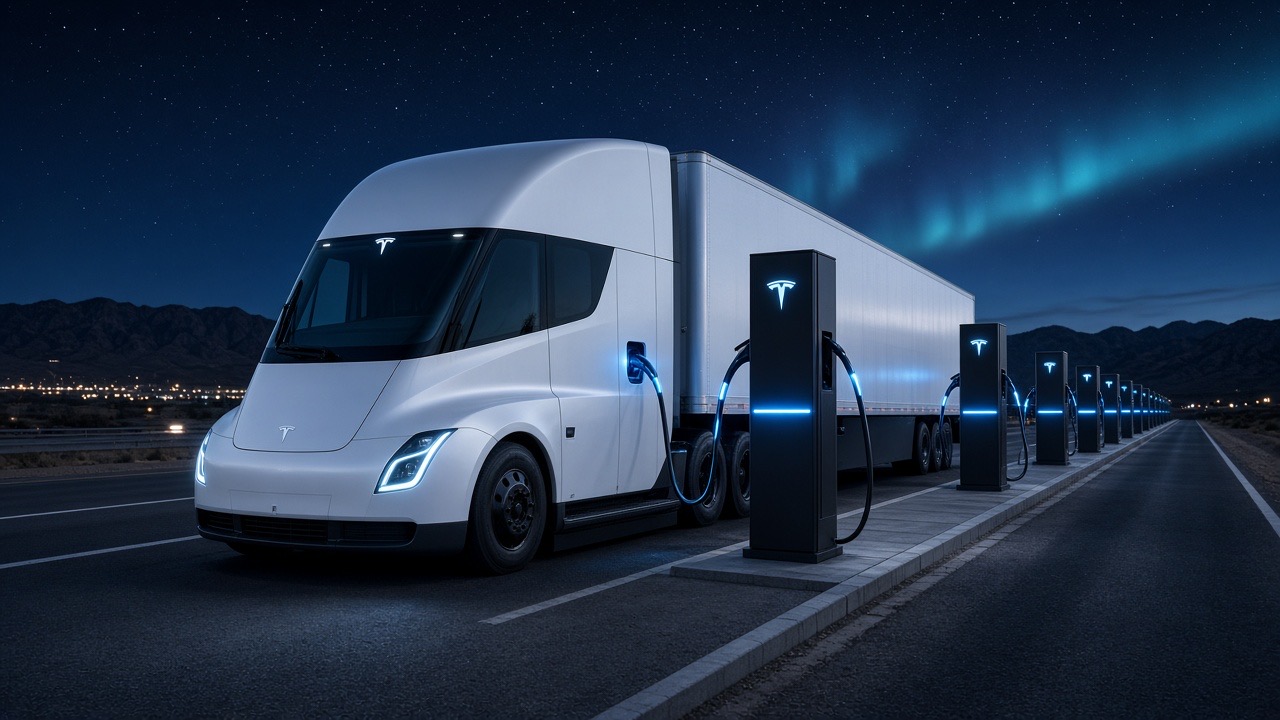
Tesla is lining up Semi trucks and high-power charging at the same time. The truck needs range and charge speed. Fleets need places to plug in on freight corridors and at depots. This piece walks through the latest public numbers for the United States and Europe, and what Megacharger deployment changes for both.
Europe Semi specs on the board
In September 2026, Tesla put European Semi numbers in public view ahead of IAA Transportation in Hannover.
Reported figures tied to Tesla Europe materials include up to 550 km of range at 40 tonnes fully loaded, about 1 kWh per kilometer, curb weight around 9,100 kg, and ePTO up to 25 kW. On charging, the European Semi is quoted at up to 800 kW on Megacharger, recovering about 60% of range in 30 minutes. Customer deliveries are aimed at 2027. European list price was not published with those specs.
Those vehicle numbers sit next to a crowded European electric-truck market. The open items that still matter for fleets are price, pack configuration, and when the first customer trucks actually arrive.
Semi Charging for Business in five EU markets
On September 14, 2026, Tesla Charging said Semi Charging for Business is available in Germany, the Netherlands, Belgium, France, and the United Kingdom.
That program lets businesses buy charging hardware for their own sites. The hardware pair is the high-power Megacharger and the lower-power Basecharger for longer stays. Tesla's US product framing for the same family has cited up to 1.2 MW for Megacharger and about 125 kW for Basecharger. Depot sales are live in those five markets. A public European Megacharger corridor network was not open as of mid-September 2026 reporting around the IAA debut.
The practical read for European fleets is depot-first: fixed routes that return to a yard can buy hardware now while public corridor coverage is still forming.
Keep hardware watts and vehicle accept rate separate
Megacharger hardware is marketed up to 1.2 MW per post in Tesla Charging posts. The European Semi's published charge headline is up to 800 kW. Those are related numbers, and they are not the same claim.
US demonstrations and network posts have used the 1.2 MW figure for Megacharger stalls. Europe's truck-side 800 kW figure is what operators should use when planning European rest-stop math until Tesla publishes a different European vehicle charge rate.
Preassembled Megachargers for the Semi ramp
On September 15, 2026, Tesla Charging said the first preassembled Megachargers are deployed to support the Semi ramp. Each unit is a V4 cabinet with two posts, up to 1.2 MW per post.
Factory-assembled packs are meant to shorten field build time. Crews set a complete stall group instead of assembling the hardware piece by piece on site. Tesla Charging did not name geography for those first packs in the post. The stated purpose is supporting Semi production ramp charging capacity.
The same day, Tesla Charging also posted its first Accordion Supercharger for passenger Superchargers between parking spaces. That is a separate product line from Megacharger, with the same factory-preassemble theme.
Pilot Travel Centers in the United States
Pilot Travel Centers, the largest US travel-center operator, has an agreement with Tesla to install Semi chargers at select Pilot locations.
Pilot's own announcement says sites are planned along I-5, I-10, and other major freight corridors, with construction beginning in the first half of 2026 across California, Georgia, Nevada, New Mexico, and Texas. Equipped sites are described as four to eight stalls using Tesla V4 cabinet technology at up to 1.2 megawatts per stall. First sites are expected to open in summer 2026. The network initially focuses on Tesla Semi trucks, with possible later expansion to other heavy-duty EVs.
This is a corridor and select-site plan for the freight routes named above. Pilot operates more than 900 travel centers across 44 US states and five Canadian provinces.
US Semi production context
In April 2026, Tesla showed the first Semi off its high-volume production line at the dedicated factory next to Gigafactory Nevada. Public reporting tied to that moment said Tesla stated capacity of up to 50,000 trucks per year at that factory.
Public Megacharger pads in California, including posts about Vernon and Bloomington, and the Nevada factory area are part of the early US picture.
What deployment changes for freight
Electric Class 8 only works at scale when trucks, depot power, and corridor chargers move together.
In Europe, Tesla has published regional Semi specs, pointed to 2027 deliveries, and opened depot charger sales in five countries while public Megacharger corridors are still ahead. In the United States, high-volume Semi manufacturing is underway in Nevada, Megacharger hardware is posting 1.2 MW capability, preassembled field kits are shipping for the ramp, and Pilot is lined up for select truck-stop sites on major freight interstates.
The impact of Megacharger deployment is less about a single wattage headline and more about whether charging capacity stays ahead of truck output on real routes. Depot hardware, factory-built pads, and travel-center partners are the three public levers Tesla has put on the table so far.
Questions that still set the plan
- European list price and firm first-delivery month.
- Which battery configuration Europe actually ships.
- How many Pilot sites open on the summer 2026 aim, and on which exact exits.
- Live US public Megacharger stall census as sites go live.
- Whether preassembled Megacharger packs are landing first in US corridors, EU depots, or both.
- When a public European Megacharger corridor network opens.
Those answers are still open. Semi volume and Megacharger buildout are moving as one program.
Not investment advice.
Not investment advice.