SpaceX · Starship · Starlink · Space economy
Starship Flight 14 Could Change the Space Industry Forever
By Jason @bauminater · September 16, 2026 · 5 min read
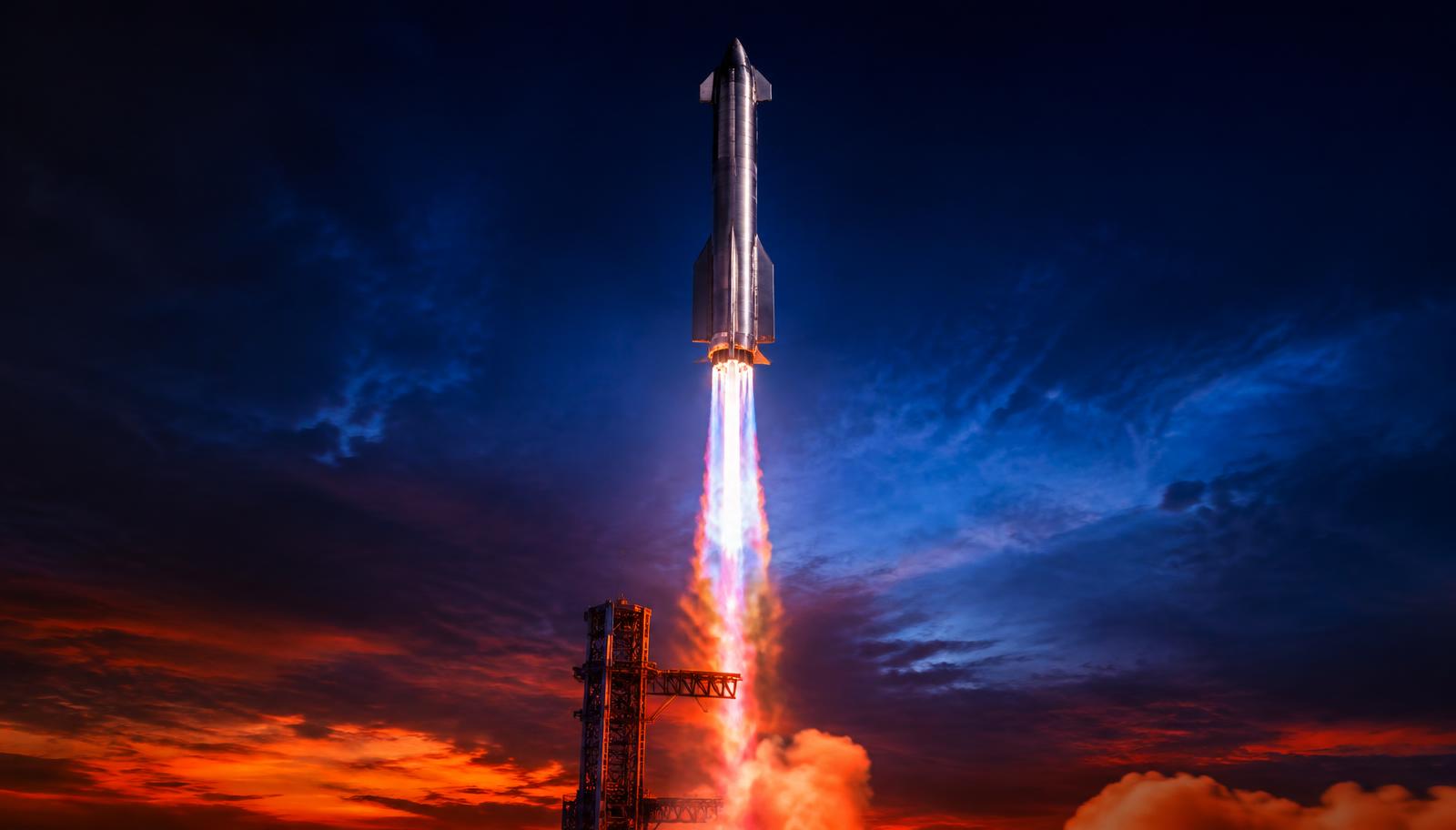
Starship Flight 14 could be the launch that makes the space industry look completely different. Not simply because Starship is the largest rocket ever developed, and not because it could eventually take humans to Mars, but because SpaceX may be getting close to something far more consequential: turning spaceflight into an industrial process.
SpaceX is targeting September 15 for Starship's next flight. The mission is expected to be Starship's first true orbital flight and could deploy Starlink V3 satellites per an FCC filing. That distinction matters. This isn't simply another test of whether Starship can get off the launchpad — it's another step toward proving that an enormous, fully reusable spacecraft can become a practical transportation system.
Starship isn't really the product
We've become accustomed to thinking about rockets as the product. You build a rocket, you launch a satellite, you go to space, you repeat. SpaceX is attempting something fundamentally different: Starship is infrastructure.
The objective isn't merely to build a bigger rocket. It's to create a reusable transportation system capable of moving enormous amounts of mass between Earth and orbit at a frequency and cost that were previously impossible.
- More launches and more satellites.
- More bandwidth and more scientific experiments.
- More space stations and commercial activity.
- More opportunities to build things in orbit.
The rocket becomes the equivalent of a railroad, a highway or a shipping network. The real economic value isn't necessarily in the transportation system itself — it's in everything that becomes possible because the transportation system exists.
And then there's Starlink
One of the most interesting aspects of Starship's development is what SpaceX intends to put inside it: Starlink V3. SpaceX has already demonstrated Starship's ability to deploy V3 hardware during a previous mission. The next step is putting operational satellites into orbit.
Starlink is effectively becoming one of the primary early customers for Starship, and that creates an unusual feedback loop. Starship launches Starlink. Starlink generates revenue. That revenue helps fund Starship. Starship makes Starlink faster and more capable. The two systems reinforce each other, and the potential scale is enormous.
The bigger opportunity is above Earth
We've spent decades asking what humans can do in space. Starship could force us to start asking a completely different question: what becomes economically possible when getting to space becomes cheap and routine?
Imagine an environment where companies can routinely send massive payloads into orbit. Suddenly, concepts that were previously dismissed as economically impossible become worth considering.
- Orbital manufacturing.
- Massive communications infrastructure.
- Large-scale space stations.
- Lunar infrastructure and fuel depots.
- Space-based solar power.
- Eventually, perhaps AI computing infrastructure in orbit.
Some of these ideas may fail. Others may take decades. But the important point is that the economics change before the applications do.
And this is where AI enters the story
AI requires enormous amounts of computing power. Computing requires enormous amounts of electricity. And building enough power generation and data-center infrastructure on Earth is becoming increasingly difficult.
Now combine AI, abundant solar energy, enormous launch capacity and autonomous systems. Starship could eventually provide the transportation layer. Starlink could provide the communications layer. AI could provide the intelligence, robotics could provide the labor, and solar energy could provide the power. An industrial economy operating partially beyond Earth starts to sound extremely difficult rather than absurd — but technically conceivable.
What nobody is talking about
Most conversations about Starship focus on whether it will successfully launch. That's understandable, but I think we're asking the wrong question. The important question isn't whether Starship works. It's what happens if Starship works really well.
A reusable spacecraft capable of moving massive payloads into orbit isn't merely another advancement in rocketry. It's a potential platform for an entirely new economy. The biggest impact may not be putting humans on Mars, and it may not even be Starlink. It could be the moment when space stops being an exclusive destination and starts becoming an industrial environment.
If SpaceX succeeds, future generations may look back at Starship the way we look at the early railroads, highways and commercial aviation — not as the destination, but as the infrastructure that made everything else possible.
Not investment advice.